India is rapidly transitioning to a more sustainable and greener future, and solar energy is essential to this process. The Government of India launched the Har Ghar Solar Scheme, a flagship project designed to provide reasonably priced solar power to houses all around the country, in order to make renewable energy available to every household.This program is aimed to revolutionize how Indian families use and produce energy by lowering This program is expected to alter how Indian families consume and create energy by cutting electricity costs, fostering energy independence, and contributing to environmental preservation.ring electricity prices, encouraging energy independence, and contributing to environmental preservation.
Prime Minister Narendra Modi presented the program, also known as PMSG, in India’s 2024–2025 interim budget on February 15, 2024. It intends to give 300 units of free electricity per month to about 1 crore homes by enabling them to install rooftop solar systems with an allocation of more than ₹75,000 crore.
The system’s capacity is used to determine subsidies:
In order to be eligible, candidates need to:
Households who are interested must register by choosing their state and power provider (DISCOM) on the official national portal (pmsuryaghar.gov.in, for example). The website helps choose a vendor, offers information about the solar subsidy and its viability, and allows for direct subsidy disbursement to the beneficiary’s bank account, usually within 30 days after installation.
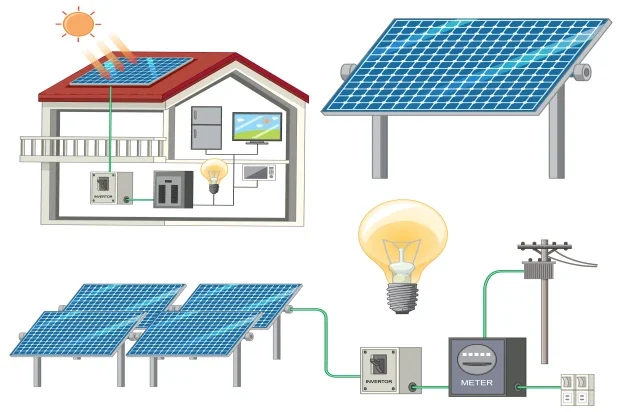
The Pradhan Mantri Surya Ghar Muft Bijli Yojana, also known as the Har Ghar Solar Scheme, helps families reduce their power costs by providing up to 300 units of free electricity each month to households. Renewable energy is now more accessible for recipients thanks to government incentives of up to ₹78,000 for rooftop solar installation. One crore families in India are the focus of the program, and within 30 days of installation, subsidies are sent straight to bank accounts.
A nationwide online platform (pmsuryaghar.gov.in) has been introduced to streamline the registration, vendor selection, and subsidy tracking processes. Another advantage of net metering is that it enables households to generate extra revenue by selling excess electricity back to the grid. Millions of houses are expected to become sustainable power generators thanks to the Har Ghar Solar Scheme, which promotes energy self-reliance, lowers carbon emissions, and advances India’s renewable energy targets.
Introduced as a flagship government solar program, the Har Ghar Solar Scheme offers numerous benefits to homeowners and the country as a whole.
Even though the Har Ghar Solar Scheme is a ground-breaking project, there are some obstacles that must be overcome for householders and legislators to successfully adopt it.
With the goal of transforming every home into a source of sustainable and clean electricity, the Har Ghar Solar Scheme represents a watershed in India’s renewable energy development. As the government’s premier solar program, it unifies environmental responsibility, energy independence, and financial assistance. The program directly helps households while bolstering India’s long-term energy security by providing free electricity, alluring subsidies, and chances to profit from excess power.
The scheme’s goal of enabling residents to take control of their energy future is still obvious, despite obstacles including awareness gaps, upfront expenses, and state-level policy overlaps. The Har Ghar Solar Scheme could transform millions of homes, lower carbon emissions, and hasten India’s transition to a global leader in renewable energy with more adoption, improved outreach, and supportive state legislation.
Get the latest updates on solar schemes, exclusive offers, and energy-saving tips delivered straight to your inbox.
© 2025 Arrow Power Controls – Developed by Digital Marketing Partner
WhatsApp us
Arrow Solar